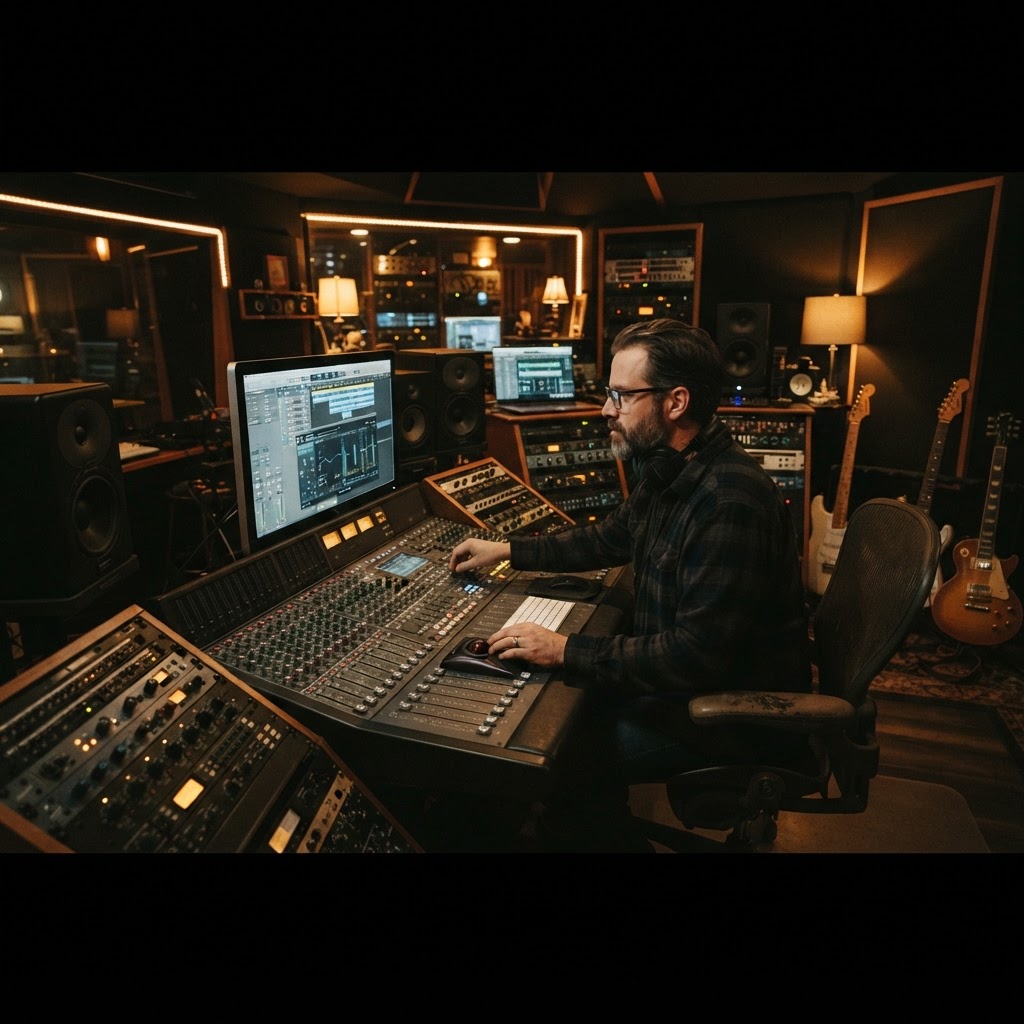
HOME STUDIO
Don't Fear the Robot: A Veteran's Practical Guide to AI in Music Production
Veteran sound engineer Bob Williams shares how to integrate AI tools into your workflow without losing your creative soul.
Hey there. I'm Bob. If you had told me back in 1982, while I was hauling heavy racks of outboard gear into a Scottsdale club, that one day a computer program would be able to 'listen' to a vocal and strip away the air conditioner hum perfectly, I would have laughed you right out of the room. But here we are. I’ve spent over forty years behind consoles, and I’ve seen every 'game-changer' come and go. Digital recording, Auto-Tune, plugins that look like vintage Fairchilds—they all had their era of being the 'end of music.' Now, it’s AI.
If you’re just starting out in your home studio and taking the 'Sound Check with Bob' course, you might be feeling two things: excitement about the shortcuts and a bit of a sinking feeling that the machine might be doing the work for you. Let’s clear the air right now. AI in music production is just another tool in the box, like a compressor or a soldering iron. It’s here to take the grunt work off your plate so you can focus on the soul of the song.
The Clean-Up Crew
One of the most practical ways I use AI in my sessions is for audio restoration. I remember one session in a garage studio off Shea Boulevard—it was mid-July, the AC was screaming just to keep the tubes from melting, and we were trying to cut a delicate acoustic track. We didn’t have AI back then; we had to wrap the singer in moving blankets and pray. Today, you’d just use a tool like iZotope RX. It uses machine learning to identify noise and separate it from the signal.
Don’t be afraid to use these tools to save a performance. If your singer captured the perfect emotion but the neighbor started their lawnmower, let the AI handle the noise. You aren't 'cheating'; you're preserving the art. Just be careful not to over-process. If you push the repair settings too hard, you’ll start to hear these weird watery artifacts that sound like the singer is underwater. Trust your ears, not just the 'Auto-Repair' button.
Mixing with a Virtual Assistant
Then there’s mixing. There are a lot of plugins out there now—like Neutron or Sonarworks—that analyze your track and suggest EQ curves or compression settings. For a beginner, this is a goldmine. Why? Because it gives you a starting point. It’s like having a senior engineer lean over your shoulder and say, 'Hey, maybe dip a little 400Hz out of that snare.'
But here’s the kicker: don’t treat those suggestions as gospel. AI looks at frequency charts and mathematical averages. It doesn't know the vibe you’re going for. It doesn't know that you want the bass to feel 'fuzzy' or the vocals to feel 'intimate.' Use the AI to get the track into a healthy ballpark, then turn the knobs yourself to find the heart of the mix. I always tell my students: use the tool to see what’s possible, then use your brain to decide what’s right.
The Creative Spark Plug
We’re also seeing AI that can generate MIDI patterns or even full backing tracks. Some folks think this is the death of songwriting. I disagree. I see it as a high-tech version of a randomizer. If you’re stuck on a chord progression, there’s no shame in letting a tool like Orb Producer throw a few ideas at the wall.
The trick is to treat these AI outputs as raw material, not the finished product. Take that AI-generated melody, change three notes, swing the rhythm, and suddenly it’s yours. It’s a spark, not the fire. The fire comes from your experience, your heartbreak, and your unique way of seeing the world. A machine doesn't have a story to tell; you do.
So, as you build out your home studio here in Scottsdale or wherever you might be, don’t run away from the new tech. Embrace it, learn its limits, and keep your hands on the steering wheel. We aren't being replaced; we're being upgraded. The gear changes, but the goal stays the same: moving the listener.
Remember, the machine provides the data, but only you can provide the soul.
EAR-TRAINING FIELD TRIP

Decatur, GA, USA
Eddie's Attic
YOUR EXERCISE HERE
Find a seat right in the middle of the room during a soundcheck or an acoustic set and close your eyes. Focus on the 'tail' of a snare hit or a vocal phrase to hear how the wooden surfaces create a natural decay; that organic fade is exactly what we're trying to replicate when we tweak AI-generated reverb parameters to sound 'human'.
Free Listening Worksheet
5 questions on sound & music (2 fill-in-the-blank). Take it to the venue.
Get the six cheat sheets — free
One page each for room acoustics, gain structure, live sound, mixing, mic placement and guitar setup. The numbers and the moves, nothing else.
No spam. Unsubscribe anytime.
You Just Read the Free Version.
The full Sound Check course turns this into a system — 8 modules, 6 hours, a room that finally sounds right.
ENROLL NOW — $97