GUITAR MAINTENANCE
Mastering Your Guitar Setup: Why Intonation Matters More Than You Think
Learn the essentials of guitar intonation and basic setup from a veteran sound engineer to ensure your instrument plays perfectly in tune.
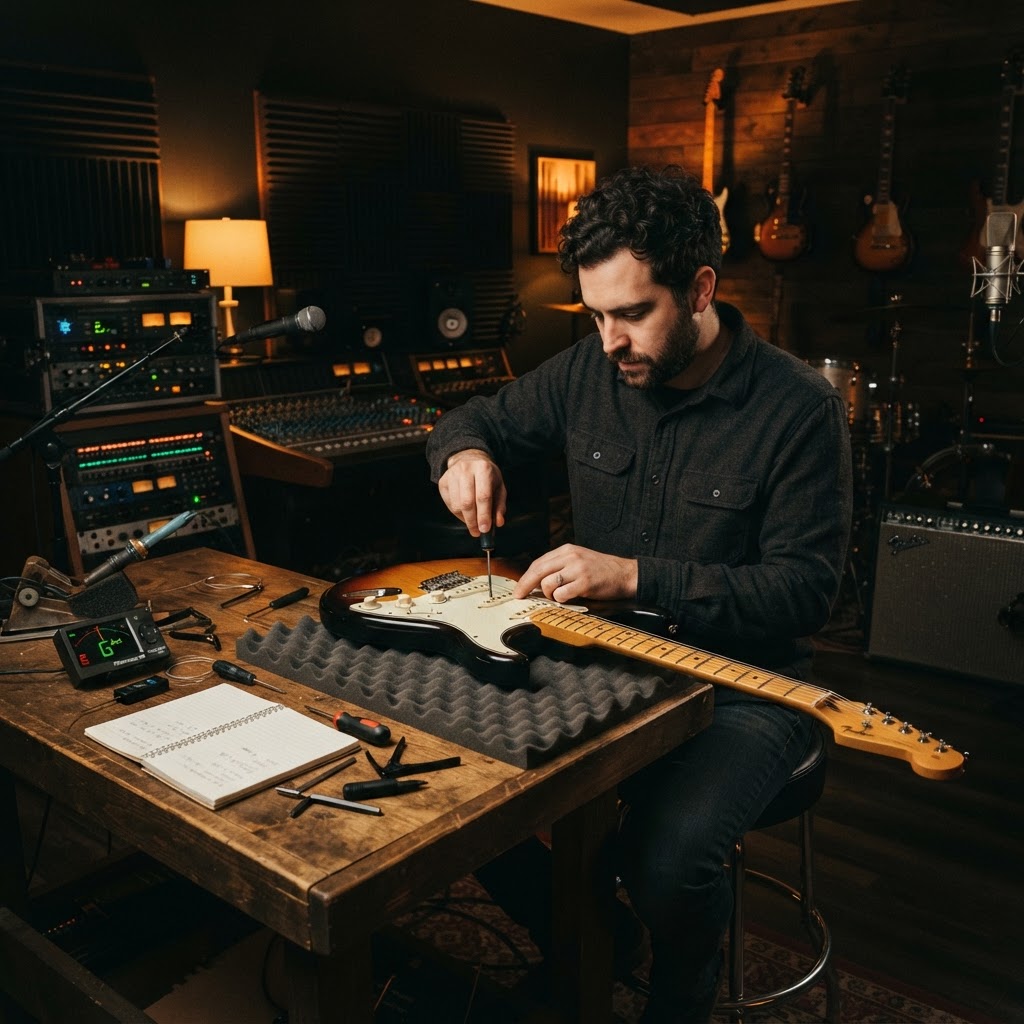
Hey there. I'm Bob Williams, and if you've spent any time in my studio here in Scottsdale, you know I don't have much patience for gear that fights the player. Over my 40 years in the business, I’ve seen hundreds of great musicians struggle on stage simply because their guitar wasn’t set up correctly. If your open strings sound perfect but your chords sound like a train wreck at the 12th fret, it’s not you—it’s your intonation. Let's get that sorted out.
The Foundation: Check Your Relief and Action Before you touch the bridge, check your neck. If your strings are too high, you’re pulling them sharp every time you press down. Hold the low E string down at the first and 14th frets simultaneously. There should be a tiny gap—about the thickness of a business card—at the 7th fret. That’s your neck relief. If it’s flat against the frets, you’ll get buzzing. If it’s like a bow and arrow, you’ll never get the intonation right. Get the neck straight and the action comfortable first. If you aren't comfortable adjusting a truss rod, take it to a shop. It’s cheap insurance for your instrument.
Taming the 12th Fret Intonation is all about length. If a string is perfectly in tune open but plays sharp at the 12th fret, the string is effectively too short for the scale length. You need to move that saddle backward, away from the neck, to lengthen it. If it plays flat at the 12th fret, the string is too long—move the saddle forward. Use a high-quality strobe tuner or a reliable software app. Play the open string, then play the harmonic at the 12th fret, then the fretted note at the 12th. If those three don't match, your bridge saddles need an adjustment. It’s a slow, incremental process of turning the screw and re-tuning. Do it in small, quarter-turn increments.
Consistency Is Your Best Friend Remember that intonation changes with every string gauge change. If you’ve been playing .009s and decide to switch to .011s, your guitar will need a setup. The extra tension pulls the neck forward and shifts the bridge requirements. Also, keep your strings fresh. Old, oxidized strings will never intonate correctly because the mass along the string isn't consistent. Don’t chase perfect intonation on a dead set of strings; you’re just wasting your time. A simple setup makes a cheap guitar sound pro and a pro guitar feel like butter. Take the time to learn these basics, and you’ll spend less time fighting your instrument and more time actually making music. I tell all my students in 'Sound Check with Bob' that a well-maintained guitar is the first step toward a great performance. If you need a hand, just remember that patience is the best tool in your kit. Just take it slow and listen to what the instrument is telling you. You’ve got this.
EAR-TRAINING FIELD TRIP

Nashville, TN, USA
Ryman Auditorium
YOUR EXERCISE HERE
Find a seat in the pews during a quiet moment and close your eyes to listen to the natural decay of the room. Focus on how the wooden architecture sustains the high-end frequencies of an acoustic instrument, and try to identify if any specific notes seem to 'bloom' or resonate more than others due to the room's unique geometry.
Free Listening Worksheet
5 questions on sound & music (2 fill-in-the-blank). Take it to the venue.
You Just Read the Free Version.
The full Sound Check course turns this into a system — 8 modules, 6 hours, a room that finally sounds right.
ENROLL NOW — $97