GUITAR MAINTENANCE
Stop Fighting Your Fretboard: A Veteran's Guide to Intonation and Setup
If your guitar sounds out of tune as you move up the neck, your intonation is off. Here is how to fix the basics without needing a professional luthier.
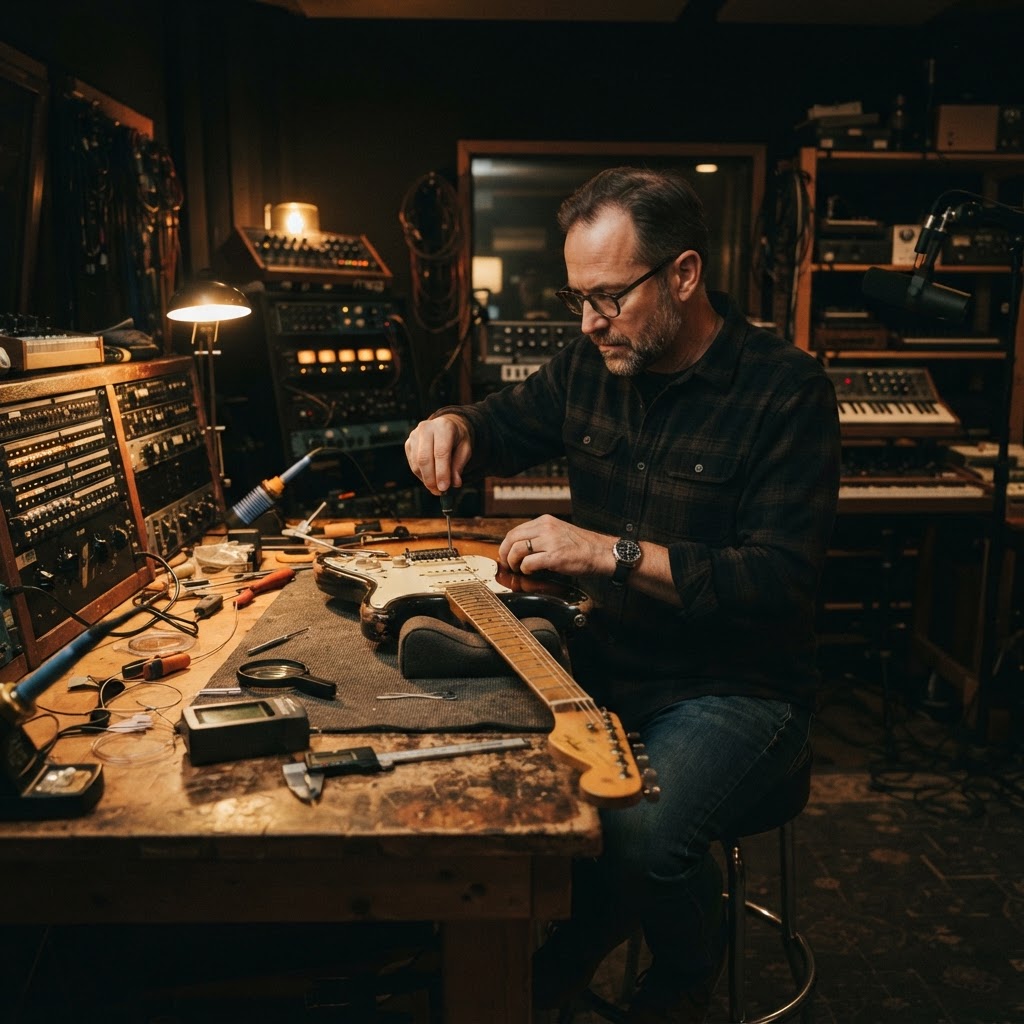
Hey there. I'm Bob Williams, and after four decades of wrestling with unruly instruments on stage and in the studio here in Scottsdale, I can tell you one thing for certain: most guitarists spend their lives fighting an instrument that just needs a little bit of common-sense maintenance. We talk a lot about gear, but the most important piece of equipment you own is the one you play every day. If your guitar doesn't feel right, you won't play it. And if it doesn't sound in tune above the fifth fret, you’re never going to get the results you want. Let's talk about the basics of getting your guitar working for you, not against you. The Foundation: Relief and Action Before you touch the bridge saddles, look at the neck. If your strings are sitting a mile off the fretboard, your hand will cramp, and you'll naturally pull the strings sharp when you fret them. First, check your neck relief. Hold down the first fret and the fourteenth fret simultaneously. Look at the gap between the string and the eighth fret wire. You want a tiny bit of space—about the thickness of a business card. If it’s flat against the fret, your truss rod is too tight. If there’s a canyon, it’s too loose. Adjust that truss rod in quarter-turn increments. Once the neck is straight, set your string height at the bridge so it feels comfortable for your style. Don't go so low that you get fret buzz, but remember: you don't need to fight the metal. Mastering the Saddle Intonation So, your action is good, but you notice that your chords sound perfect at the nut and sour at the twelfth fret. That’s an intonation issue. It happens because the physical length of the vibrating string changes when you press it down. Grab a high-quality strobe tuner—don't trust the clip-on one you left in your gig bag for three years. Play the open string, then play the harmonic at the twelfth fret, and finally fret the note at the twelfth fret. If the fretted note is sharp compared to the harmonic, your string is too short. You need to move the bridge saddle back, away from the neck. If the fretted note is flat, the string is too long, and you need to move the saddle forward toward the neck. Turn the adjustment screw a half-turn, re-tune, and check again. It’s tedious, and yes, it’s boring, but it’s the difference between sounding like an amateur and sounding like a pro. The Secret to Longevity One final tip: change your strings, and for heaven's sake, stretch them. A lot of players install a new set, tune up, and start playing immediately. That’s a mistake. Once you’ve got the new strings on, give each one a firm tug up and down the neck. Retune, stretch, and repeat until the pitch holds. If you don't do this, your intonation adjustments won't matter because the strings will be shifting constantly. When you treat your guitar like a fine-tuned machine rather than a piece of furniture, your playing will improve almost overnight. You’ve got the talent, so stop letting a neglected bridge or a bowed neck get in your way. Take an hour this weekend, get these basics locked in, and then get back to the music.
EAR-TRAINING FIELD TRIP

Nashville, TN, USA
Ryman Auditorium
YOUR EXERCISE HERE
Find a seat in the pews and close your eyes during a quiet moment of the performance. Listen specifically for how the natural decay of the notes interacts with the wooden architecture, and try to distinguish the direct sound from the room's resonance to understand how a well-set instrument should bloom in a space.
Free Listening Worksheet
5 questions on sound & music (2 fill-in-the-blank). Take it to the venue.
Get the six cheat sheets — free
One page each for room acoustics, gain structure, live sound, mixing, mic placement and guitar setup. The numbers and the moves, nothing else.
No spam. Unsubscribe anytime.
You Just Read the Free Version.
The full Sound Check course turns this into a system — 8 modules, 6 hours, a room that finally sounds right.
ENROLL NOW — $97