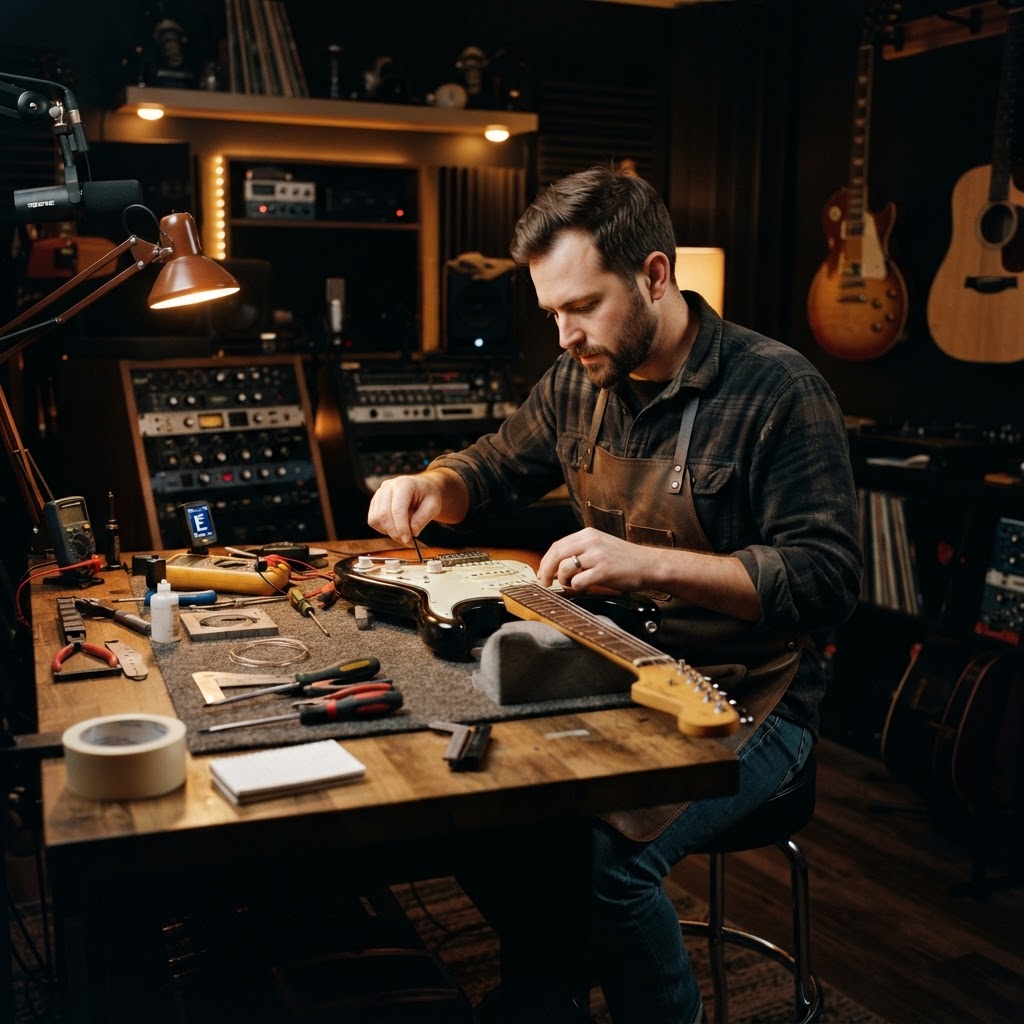
GUITAR MAINTENANCE
Stop Fighting Your Fretboard: The Essentials of Guitar Setup and Intonation
Learn how to diagnose your guitar's tuning issues and perform a basic setup to ensure your instrument plays perfectly from the first fret to the twenty-second.
After forty years in the studio and behind a mixing console, I have seen hundreds of talented players struggle with gear that was fighting them every step of the way. You can be the best player in Scottsdale, but if your intonation is off, you are going to sound out of tune no matter how precise your fingers are. Let's fix that. The Anatomy of a Setup Before you touch a single screw, understand that a guitar is a machine of tension. A basic setup starts with the neck relief. Hold down your low E string at the first fret and the fourteenth fret simultaneously. Look at the gap between the string and the seventh fret. You are looking for a hair of clearance—about the thickness of a business card. If the string is touching the fret, your truss rod is too tight. If it is high enough to park a truck under, it is too loose. A quarter-turn is usually all it takes to get you back in the ballpark. Take it slow and let the wood settle for a few minutes before checking it again. Conquering Intonation Intonation is often the most misunderstood part of maintenance. You tune your guitar perfectly open, but as you climb up the neck, the chords start to sound 'sour.' That is an intonation issue. To check yours, play your harmonic at the twelfth fret, then compare it to the fretted note at the twelfth fret. If the fretted note is sharp, your string length is too short; you need to move the bridge saddle back away from the neck. If it is flat, move the saddle forward. Use a high-quality strobe tuner for this. This is not a race, and it is not a guess. Work on one string at a time, and remember that changing the saddle position changes the tension, so you will need to re-tune to pitch before checking again. It is a cyclical process, but it is the difference between sounding like a hobbyist and a professional. Finishing Touches Once your relief is set and your bridge saddles are dialed in, check your action. Action is purely preference, but if you have to squeeze the life out of your strings just to get a clean note, you are going to fatigue during your set. I prefer a slightly higher action for rhythm work to keep the sustain up, but keep it low enough that your wrist doesn't scream at you. If you have been playing on a 'factory' setup for years, you are missing out on the true potential of your instrument. Take an afternoon, clear your workbench, and get your hands dirty. Your ears will thank you, and your audience will notice the clarity in your playing. A well-maintained guitar is not just a tool; it is a partner that makes the hard parts of music feel effortless.
EAR-TRAINING FIELD TRIP

Nashville, TN, USA
Ryman Auditorium
YOUR EXERCISE HERE
Find a seat in the middle of the room and close your eyes during an acoustic set. Listen specifically for how the natural wooden pews and the hall's unique architecture sustain the decay of a guitar note, and try to distinguish the direct sound from the room's natural reverberation.
Free Listening Worksheet
5 questions on sound & music (2 fill-in-the-blank). Take it to the venue.
Get the six cheat sheets — free
One page each for room acoustics, gain structure, live sound, mixing, mic placement and guitar setup. The numbers and the moves, nothing else.
No spam. Unsubscribe anytime.
You Just Read the Free Version.
The full Sound Check course turns this into a system — 8 modules, 6 hours, a room that finally sounds right.
ENROLL NOW — $97