LIVE SOUND
Taming the Squeal: A Veteran's Guide to Stage Performance and Feedback Control
Feedback kills stage confidence faster than a broken string. Here is how to position your gear, use your mic properly, and keep your live sound pristine.
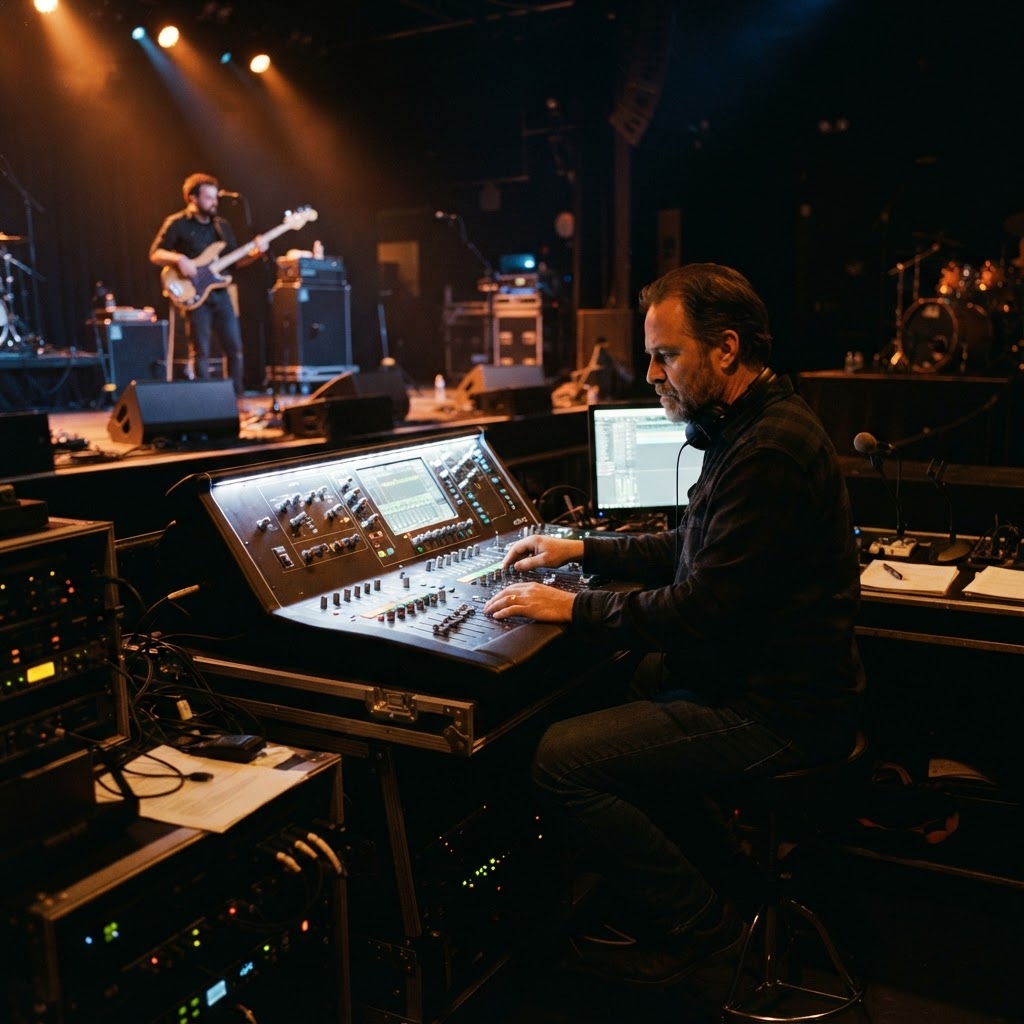
After forty years behind the mixing console and on the bandstand here in the Arizona desert, I have heard every flavor of feedback imaginable. Low rumble, piercing high shrieks, and that mid-range howl that makes an entire audience cringe at once. Most beginners assume feedback is purely a sound guy problem. Truth is, clean live sound is a fifty-fifty partnership between the engineer and the performer on stage.\n\nFeedback happens when an amplified sound leaves a speaker, enters a microphone, and gets re-amplified in an endless loop. Breaking that loop is physics, not magic. Here is how you take control of your stage sound before you ever strike the first chord.\n\nMicrophone Physics and the Cardinal Sins\n\nThe most common mistake I see young vocalists make is cupping the microphone grille. Rappers and rock singers love doing it because it looks aggressive on video. What you are actually doing is blocking the acoustic ports engineered into the mic capsule. That turns your directional cardioid mic into an omnidirectional mic instantly, picking up sound from every monitor on the floor. Hold the mic by the barrel, never the basket.\n\nNext comes your distance to the capsule. The closer your lips are to the windscreen, the higher the ratio of your voice versus the ambient noise on stage. When you pull the mic eight inches away while singing quietly, the front-of-house engineer has to crank your gain to hear you. That invites every floor wedge into the signal chain, and squeals become inevitable.\n\nLastly, watch where you walk. When you step out in front of the main PA speakers with a live mic, you are walking straight into the feedback zone. If the venue has floor wedges, remember that the rear of a standard Shure SM58 rejects sound best. Point the rear of the mic directly at the monitor horn, never the face.\n\nWinning the Stage Volume War\n\nEvery decibel you generate on stage is a decibel your sound tech has to fight. Guitarists, I love a screaming tube amp as much as anyone, but pointing a 50-watt combo directly at your ankles just forces you to turn it up until it blasts the front row.\n\nPut your amplifier on an amp stand or tilt it back so the speaker points at your ears. You will hear yourself with startling clarity at half the volume. This cleans up the vocal mics across the front of the stage immediately, because bleed is the number one instigator of rogue feedback loops.\n\nIf you are using floor monitors, ask the engineer for what you truly need, not the full record mix. Vocals and pitch references like a keyboard or acoustic guitar belong in your wedge. Cranking kick drum, bass, and distorted guitars through a small stage monitor is a surefire recipe for mud and phase-induced howl.\n\nCommunicating During the Sound Check\n\nWhen you arrive for sound check, do not just make random noise. Play a complete song at your actual gig performance volume. Whispering during sound check and screaming during the set guarantees a feedback disaster three minutes into the first tune.\n\nIf you hear a ring creeping in, keep your hands off the volume knobs on your instruments and do not tap the mic. Catch the engineer's eye, point calmly at the monitor or source that is ringing, and use a clear hand signal to indicate down. We know the frequencies, but we need you to stay calm while we notch out the problem with our parametric EQ.\n\nGreat live sound isn't an accident; it is the natural result of discipline, clear communication, and respecting the laws of acoustics.\n\nMaster your stage discipline, and you will never fear the feedback beast again.
EAR-TRAINING FIELD TRIP

Nashville, TN, USA
Ryman Auditorium
YOUR EXERCISE HERE
Take a seat mid-hall in the curved wooden pews and close your eyes during soundcheck or a vocal performance. Listen closely to the direct sound of the singer's voice coming straight from the PA compared to the warm, natural reflections bouncing off the curved wooden ceiling and balcony face. Notice how acoustic energy blooms without decaying into harsh flutter echo, and train your ears to identify where that natural room resonance ends and potential system feedback begins.
Free Listening Worksheet
5 questions on sound & music (2 fill-in-the-blank). Take it to the venue.
You Just Read the Free Version.
The full Sound Check course turns this into a system — 8 modules, 6 hours, a room that finally sounds right.
ENROLL NOW — $97