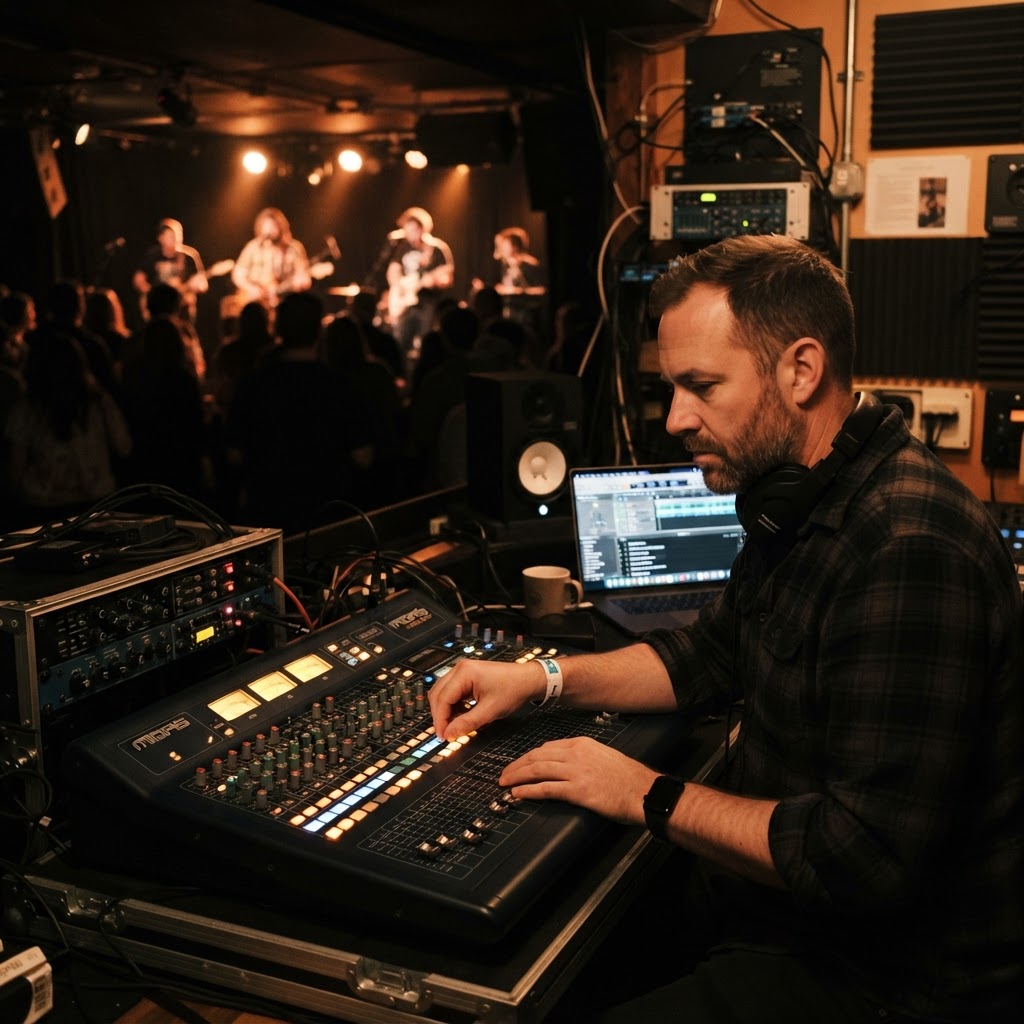
MIXING
The Fader First Approach: Mastering the Basics of a Clean Mix
Stop overcomplicating your signal chain and learn the three fundamental pillars of mixing that veteran engineer Bob Williams uses to create professional sound every time.
Hey there. Pull up a chair. I’m Bob Williams. I’ve spent the last four decades behind consoles ranging from smoky Scottsdale bars to massive outdoor festivals in the Arizona heat. If there’s one thing forty years in this business has taught me, it’s that most beginners try to do too much too fast. You’ve got a hundred plugins at your fingertips, and the temptation to use every single one of them is strong. I get it. We all want that 'radio-ready' sound instantly. But before we get ahead of ourselves, let’s take a breath and talk about the foundation.
In my "Sound Check with Bob" course, I always start with the same premise: a great mix isn't about what you add; it's about what you clear away. You aren't building a wall; you're carving a statue. If you can’t get a decent sound using nothing but your volume faders and pan knobs, a thousand-dollar compressor isn’t going to save the day. A mix is a puzzle where every piece needs its own space to sit without overlapping its neighbor.
Get the Foundation Right Before You Reach for Plugins
The most common mistake I see is "mixing with the eyes." You see a waveform on a screen and you think it needs to look like a certain shape, or you see a meter hitting red and you panic. Forget the visuals for a second. Close your eyes. The faders on your board or in your software are your most powerful tools. I call this the "Fader Mix." Before you touch an EQ, before you even think about adding reverb or delay, you need to find the natural balance of the tracks.
Start with your most important element—usually the lead vocal or the primary instrument. Bring it up to a healthy level, then slowly bring the drums and bass in around it. You’re looking for a relationship where everything can be heard clearly without fighting for dominance. If the guitars are masking the vocal, don’t just turn the vocal up until you're clipping your master bus. Instead, turn the guitars down. It sounds simple, almost too simple, but it is the absolute secret to a professional-sounding mix with plenty of headroom.
Panning is the next step in this foundational stage. Think of the soundstage like a literal stage in a theater. You wouldn’t have the whole band standing in a single file line in the dead center of the stage, would you? It would be a sonic mess. Put the kick drum, the snare, and the lead vocal in the center. Spread your guitars, keyboards, and backing vocals to the sides. This creates physical "pockets" in the stereo field for every instrument to live in, which naturally increases the clarity of your mix without you having to touch a single filter.
Carving Space with Subtractive EQ
Once your faders are set and your panning is wide, we look at EQ. Most beginners use EQ to "boost" the frequencies they like. They want more thump, so they crank the low end. They want more snap, so they crank the highs. This is a fast track to a muddy, harsh, and exhausting mix. When you boost, you're adding energy and eating up your headroom.
Instead, I want you to embrace subtractive EQ. If a mix feels "muddy," don’t boost the treble to compensate. Instead, find the instrument that is cluttering the 250Hz to 400Hz range—the "boxiness" zone—and cut it by a few decibels. My golden rule for a clean mix is the High-Pass Filter (HPF). Almost every channel in your mix, except for the kick drum and the bass guitar, should have a high-pass filter applied to it. You don't need low-end rumble on a female vocal, a violin, or a hi-hat. By cutting those unnecessary low frequencies, you give the bass and kick the room they need to provide the heartbeat of the song.
Using Compression as Glue, Not a Sledgehammer
Compression is perhaps the most misunderstood tool in the engineer's shed. Think of a compressor not as an effect, but as an automatic volume fader that works faster than your hand ever could. It turns down the loudest peaks so the quietest parts can be heard, effectively narrowing the dynamic range. In live sound, we use it to keep a singer from jumping out of the mix when they get hit with a burst of energy, or to keep a snare drum consistent throughout a set.
Start with a low ratio, perhaps 3:1 or 4:1. Set your threshold so the gain reduction meter is only moving a few decibels on the loudest peaks. You shouldn't necessarily "hear" the compressor working like a pumping sound; you should just feel the instrument sitting more solidly and consistently in the mix. If the life feels sucked out of the performance and the transients sound dull, you’ve gone too far. Back it off. Mixing is about preserving the human emotion of the music, not flattening it into a digital pancake.
Remember, your physical environment matters too. Here in Scottsdale, I’ve mixed in rooms that sounded like echoing tin cans and others that were as dead as a closet. Don't fight the room; work with it. If the room is naturally boomy, you’ll need to be even more aggressive with your subtractive EQ. After 40 years, I can tell you that the gear changes and the software updates every year, but the physics of sound stays the same. Trust your ears over your meters every single time. If it sounds good to you, it is good. Keep practicing, keep listening to your favorite records with a critical ear, and don’t be afraid to make a mess of a mix—that’s the only way you’ll learn where the boundaries are.
Your ears are the most expensive piece of gear in the room—use them first.
EAR-TRAINING FIELD TRIP

West Hollywood, CA, USA
The Troubadour
YOUR EXERCISE HERE
Listen, kid, stand right next to the soundboard and focus on how the low-end hits the back wall. You have to learn to distinguish between the direct sound from the speaker stacks and the slap-back from the room's rear to keep the low-mids from turning into mush.
Free Listening Worksheet
5 questions on sound & music (2 fill-in-the-blank). Take it to the venue.
You Just Read the Free Version.
The full Sound Check course turns this into a system — 8 modules, 6 hours, a room that finally sounds right.
ENROLL NOW — $97