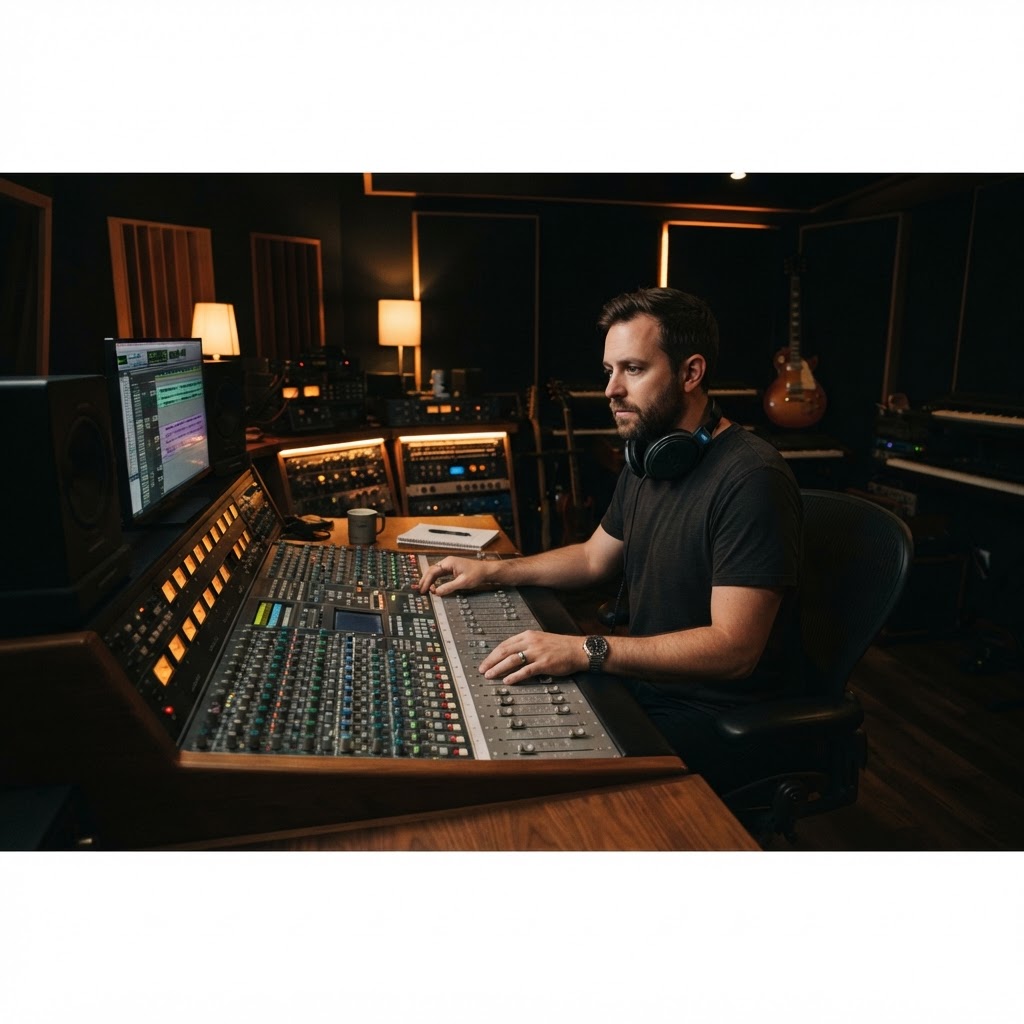
MINDSET
Why Your Brain Lies to You at the Mixing Console
Great audio engineering isn't just physics—it's perceptual psychology. Learn how your brain tricks your ears and how to fight back for cleaner mixes.
After forty years behind consoles in dark clubs, sun-baked Arizona festivals, and quiet control rooms, I can tell you a hard truth: your ears are rarely the problem. Your brain is.
Sound is physical pressure waves hitting your eardrums, but listening is entirely psychological. Your brain is constantly interpreting, guessing, and frankly lying to you about what you hear. If you want to make clean, dynamic mixes, you have to understand how your mind plays tricks on you.
The Louder-Is-Better Trap and Ear Fatigue
The most common psychological bias in audio is simple: louder always sounds better to human psychology. Push a fader up by 1 dB, and your brain won't necessarily register increased volume first. Instead, it perceives more punch, crisper top end, and greater depth.
Plug-in manufacturers know this. Many presets boost output gain slightly just so you think the processing sounds 'magical.'
To fight this, level-match everything. When you A/B an EQ or compressor setting, make sure the processed signal matches the bypass volume exactly. If it doesn't sound better at equal loudness, that fancy processing isn't helping.
Then there's ear fatigue. Spend three hours tweaking an 8 kHz boost on a vocal track, and your brain will normalize the harshness. You become desensitized. Take mandatory ten-minute breaks every hour, turn the volume down to conversational levels, and protect your perspective.
Expectation Bias: Hearing What You Look At
Your visual cortex routinely overrides your auditory cortex. We listen with our eyes far more than we care to admit.
Early in my career, I spent twenty minutes dialing in an outboard compressor on a snare drum, convinced I was shaping the punch perfectly. When I finally looked down, I realized the unit was patched into an unassigned channel. The snare didn't change at all, but my brain swore it was snapping harder with every twist of the knob.
Every engineer has done this. It's called expectation bias. You expect the knob to add warmth, so you hear warmth.
The antidote is simple: close your eyes. When you sweep an EQ, look at the wall or floor. When you adjust reverb decay, look away from the monitor. Turn off the visual spectrum analyzers occasionally and force your auditory cortex to do the heavy lifting.
Contextual Masking and the Big Picture
Your brain excels at isolating sound when it focuses. In a crowded Scottsdale bar, you can lock in on the person talking across the table and ignore the rest of the room. We call this the cocktail party effect.
In audio, this instinct works against you. Novice engineers hit the solo button and spend an hour polishing an acoustic guitar until it sounds massive, warm, and pristine. But the audience never hears that guitar in solo. When you drop it back into the mix, all that sculpted low-end turns the bass and kick drum into mud.
Mix in context. Make EQ and dynamic moves while the whole band is playing. A guitar tone that sounds slightly thin on its own often fits like a bespoke glove when surrounded by bass and drums. Stop listening to how elements sound in isolation, and start listening to how they relate to one another.
Trusting your ears starts with recognizing that your brain has biases you must actively manage.
EAR-TRAINING FIELD TRIP

Los Angeles, CA, USA
Walt Disney Concert Hall
YOUR EXERCISE HERE
Take a seat in the orchestra terrace, close your eyes, and listen to an unamplified instrument like a solo cello or violin. Pay close attention to how quickly your auditory system adjusts to the hall's natural reverb and direct sound, noting how your visual perception of the musician's physical effort usually fools you into thinking the sound is louder than it actually is. Try closing your eyes for 30 seconds at a time to decouple visual bias from your genuine acoustic perception.
Free Listening Worksheet
5 questions on sound & music (2 fill-in-the-blank). Take it to the venue.
You Just Read the Free Version.
The full Sound Check course turns this into a system — 8 modules, 6 hours, a room that finally sounds right.
ENROLL NOW — $97