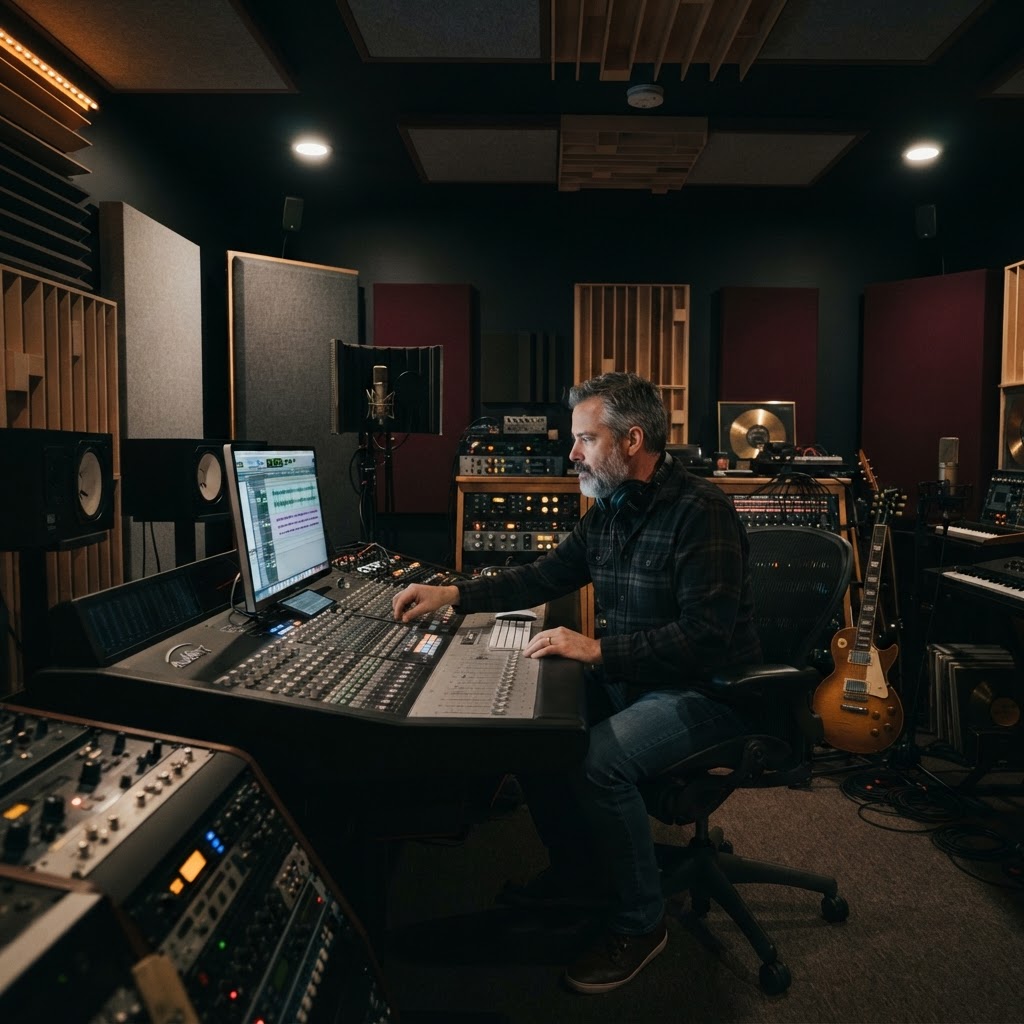
HOME STUDIO
Your Room is Your Most Important Instrument: A Veteran Engineer's Guide to Home Acoustics
Stop spending money on new microphones and start fixing the air around them; Bob Williams shares 40 years of wisdom on treating your home studio for real results.
Hey there. I’m Bob. I’ve spent the better part of forty years behind a console, from the dusty clubs of the midwest to the high-end rooms here in Scottsdale. If there is one thing I have learned after four decades of live sound and studio work, it is this: your gear is only as good as the room it is sitting in. I see it all the time in my Sound Check with Bob course. A bright-eyed songwriter comes in with a two-thousand-dollar condenser microphone and a five-hundred-dollar interface, yet their recordings sound thin, boxy, or like they were recorded inside a plastic trash can. They think they need a new preamp. They don't. They need to fix their room.\n\nPhysics doesn't care about your budget or the brand name on your speakers. Sound waves are like unruly toddlers; they run around, bounce off hard surfaces, and pile up in corners where they aren’t wanted. If you are serious about your craft, you need to stop thinking about your 'kit' and start thinking about your space. You don't need a degree in physics to get a great sound, but you do need to understand how to control the air. Here is how we get it done without wasting a fortune.\n\nTaming the Low-End Bully\n\nIn a small home studio—what we call a 'small room' in the industry—your biggest enemy is the bass. Low-frequency sound waves are long and powerful. They love to congregate in corners, creating a muddy buildup that makes it impossible to hear what is actually happening in your mix. If you have ever finished a mix that sounded great in your headphones but turned into a muddy mess in your car, you have a bass problem in your room.\n\nYour first move should always be corner treatment. We call these 'bass traps.' Don't fall for the cheap, lightweight foam wedges you see on discount websites. Those are about as useful as a screen door on a submarine for low frequencies. You need density. Look for panels made of rigid fiberglass or rock wool that are at least four inches thick. Place these in all four corners of your room, from floor to ceiling if possible. This is the single most important thing you can do. By absorbing that excess energy in the corners, you clarify the entire frequency spectrum. Suddenly, the kick drum has punch instead of a thud, and the bass guitar has definition.\n\nThe Magic of the Mirror Trick\n\nOnce the corners are handled, we need to deal with 'early reflections.' These are the sound waves that leave your speakers, hit the side walls, and bounce straight into your ears a few milliseconds after the direct sound. This causes 'comb filtering,' which makes your high-end sound harsh and your stereo image blurry. You want to hear the speakers, not the walls.\n\nHere is a trick I’ve taught for years: sit in your mixing chair and have a friend slide a small mirror along the side wall at ear height. The moment you can see the reflection of the speaker’s tweeter in that mirror, you’ve found a primary reflection point. That is exactly where you need to hang an acoustic panel. Do this for both the left and right walls. If you can afford it, put one on the ceiling between you and the speakers too—we call that a 'cloud.' By killing these early reflections, the stereo image will suddenly snap into focus. You will be able to place a vocal exactly in the center of the mix because you aren't being distracted by the wall's 'echo.'\n\nAvoid the Dead Room Trap\n\nI see a lot of beginners get overzealous and cover every square inch of their walls with foam or blankets. Do not do this. A room that is '100% dead' is an unnatural place to record or mix. It feels claustrophobic, and it leads to mixes that sound dull when you play them back anywhere else. You want a room that is controlled, not dead.\n\nIn the back of your room, behind your sitting position, you actually want some reflection, but you want it scattered. This is where 'diffusion' comes in. Instead of absorbing the sound, diffusers break it up and scatter it in different directions. This keeps the room sounding 'alive' while preventing the nasty slap-back echoes that ruin a recording. You can buy fancy wooden diffusers, but a full bookshelf with books of varying sizes and depths works surprisingly well as a DIY solution. The goal is to break up those flat, parallel surfaces that cause standing waves. Mix absorption in the front and corners with a little bit of diffusion in the back, and you will have a space that sounds professional and feels comfortable to work in.\n\nTreating your room isn't as 'sexy' as buying a new guitar or a shiny plugin, but it is the foundation of everything you do. Spend three hundred dollars on rock wool panels before you spend another dime on gear. Your ears—and your listeners—will thank you.\n\nYour room is the most important link in your signal chain, so treat it with the respect it deserves.
EAR-TRAINING FIELD TRIP

Los Angeles, CA, USA
Walt Disney Concert Hall
YOUR EXERCISE HERE
Sit in the middle of the terrace section and close your eyes while the orchestra tunes up. Try to pinpoint the exact location of the oboe versus the violins; in a hall this good, the imaging should be so sharp you can practically see the sound waves moving through the Douglas fir panels.
Free Listening Worksheet
5 questions on sound & music (2 fill-in-the-blank). Take it to the venue.
Get the six cheat sheets — free
One page each for room acoustics, gain structure, live sound, mixing, mic placement and guitar setup. The numbers and the moves, nothing else.
No spam. Unsubscribe anytime.
You Just Read the Free Version.
The full Sound Check course turns this into a system — 8 modules, 6 hours, a room that finally sounds right.
ENROLL NOW — $97